
Whatever phrase you typed to get here — best church translation service, best church translation software, best church translation system — the person you have in mind is the same: someone in your pews who sits through the sermon and catches maybe a third of it. The honest answer to the search is that there is no single best. A forty-member church plant, a congregation where half the room does not carry a smartphone, and a denomination running a three-thousand-person convention need genuinely different tools. So instead of a one-to-ten ranking, here are the category winners for 2026 — each with its published price, who it actually fits, and one honest limitation. For the deeper decision framework behind these picks — human interpreters, receiver hardware, event platforms, and church-built AI, and when each is right — read the full guide.
The short versionOur picks at a glance.
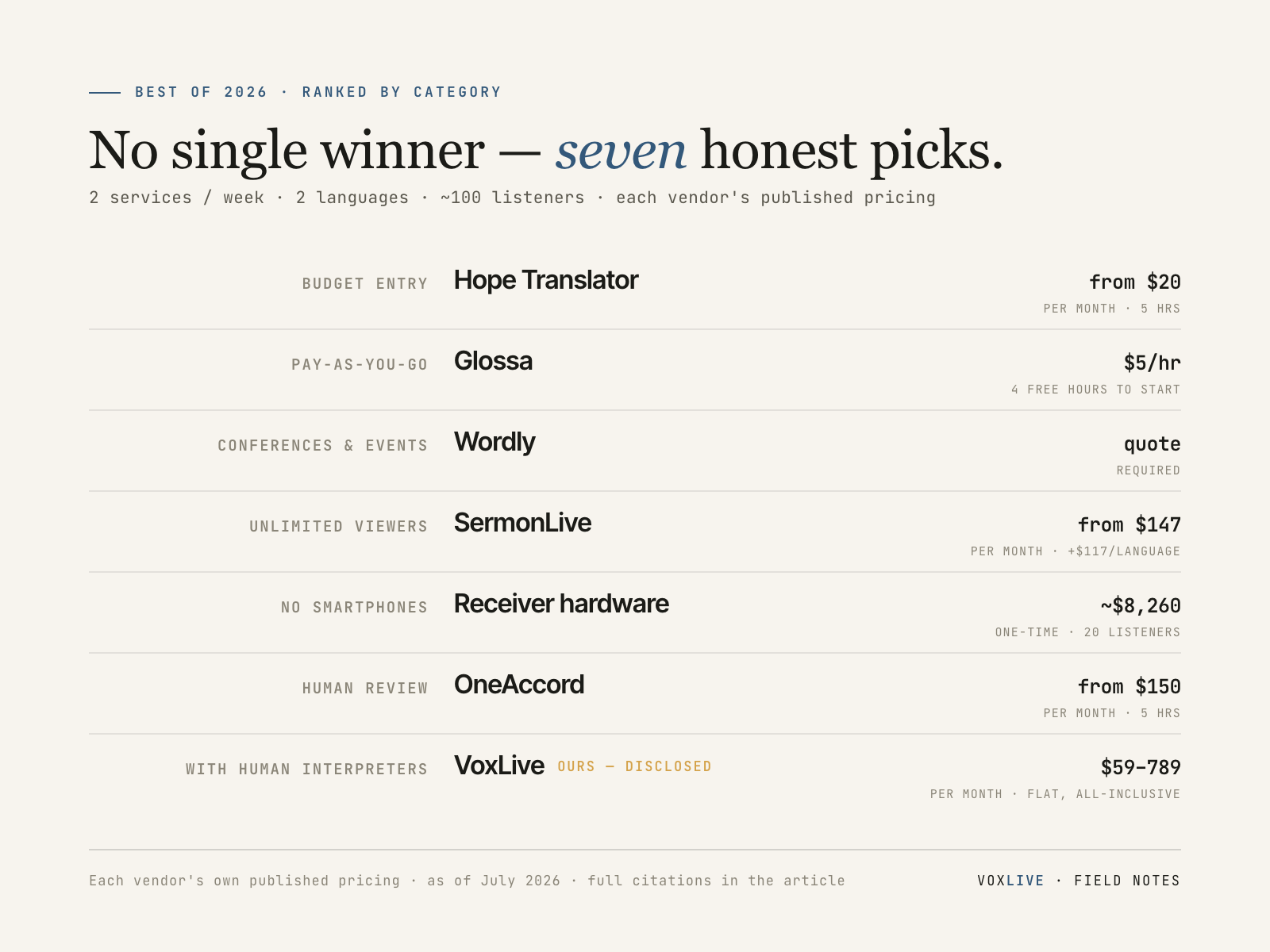
| Category | Our pick | Published price · Jul 2026 |
|---|---|---|
| Best budget entry | Hope Translator | from $20/mo — 5 hrs, 2 languages; 30 free min/mo |
| Best pay-as-you-go | Glossa | $5/translation-hr per language (4 free hrs); $99/mo for 25 hrs |
| Best for conferences & one-off events | Wordly | quote required — annual hour bundles, all languages included |
| Best for unlimited viewers | SermonLive | $147/mo + $117/mo per extra audio language |
| Best without smartphones | Receiver hardware (e.g. Williams Sound Digi-Wave) | ~$7,295 list, one-time — 20 listeners, 1 language |
| Best human-review workflow | OneAccord | from $150/mo — 5 hrs; scales by quote |
| Best with human interpreters · best all-inclusive pricing | VoxLive (ours) | Free–$789/mo flat, no per-language fees; $5 First Sunday Pass |
01 — Best budget entryHope Translator.
If the budget conversation starts and ends at "what is the least we can spend to find out if this helps," Hope Translator is the answer as of July 2026. It has the lowest published entry price in the category — $20 a month for 5 hours with 2 languages — and, better, 30 free minutes every month with no card required, the smoothest free on-ramp we have found anywhere in this market. The experience is the modern phone-based one: the person in the pew scans a code and follows the sermon on their own phone.
Who it's best for. A church testing whether translation changes anything — whether the family that catches a third of the sermon actually stays for coffee when they catch all of it — before committing real budget to any platform, ours included.
The honest limitation. The entry tier is sized for a taste, not a schedule. Five hours is about half the two-service benchmark's usage, and two languages is the floor of multilingual ministry — a weekly church should expect to need a larger plan than the entry tier. That is fine; just price the plan you will actually live on, not the one on the banner.
02 — Best pay-as-you-goGlossa.
Glossa is church-native — biblical-vocabulary tuning, the largest advertised language count in the category (100+), and the fairest metering definition we have seen: silence, music, and songs are not billed, only actively translated speech. Pay-as-you-go costs $5 per translation hour per language, with 4 free hours to start; the $99-a-month Standard plan includes 25 translation hours, with extra hours at $4.
Who it's best for. Churches whose needs are occasional or variable — a monthly bilingual service, a seasonal outreach, a congregation that wants to pay for exactly the services it uses. And here is the first place a competitor beats us: at our published weekly benchmark — two services a week, two languages — Glossa lands around $99 a month, cheaper than our own Growth plan at $199. We would rather you hear that from us than discover it later.
The honest limitation. Translation hours multiply by language count. By Glossa's own admirably clear definition, a one-hour sermon in three languages consumes three translation hours — so the meter runs faster precisely when your hospitality grows. The full math, including where each pricing model wins, is in the per-language add-on breakdown.
03 — Best for conferences & one-off eventsWordly.
Wordly is one of the most established names in live AI translation, with years of conferences, civic meetings, and corporate events behind it — if this category has an incumbent with a track record, it is Wordly. And its session model deserves credit: a session includes every language at once, which is the right way to price languages, and worth saying so.
What it costs. Quote required. Wordly sells annual hour packages — 10 hours a year up to 500+ — behind "Contact Sales." A third-party comparison (March 2026) reports about $540 a month on 12-month plans; there is no published price to verify against.
Who it's best for. Denominations and networks running large events — conventions, assemblies, synods — where per-event pricing is rational, enterprise maturity matters, and a sales conversation is normal procurement. Nonprofit discounts are advertised and worth asking about.
The honest limitation. Event math. A church meeting twice a week needs roughly 160 session-hours a year — deep in corporate-package territory — and budgeting through a sales call means the number your board approves is not one it can verify on a public page. Our full read for church AV teams is in the Wordly comparison.
04 — Best for unlimited viewersSermonLive.
SermonLive is church-built, publishes its prices, and has no viewer caps on any plan — unlimited listeners, a real advantage over most of the market, VoxLive included. If your room is large, your overflow is real, or your broadcast reaches hundreds of phones at once, no other pick on this list removes the seat-count worry so completely.
What it costs, as of July 2026. The Text & Audio plan is $147 a month with one language included; each additional audio language is $117 a month, so two languages run $264 a month. All plans include 10 hours a month, with a 14-day free trial and a 30-day money-back guarantee — generous, plainly stated terms.
Who it's best for. English-pulpit churches with big rooms and one or two target languages, especially where listener count is the variable that keeps growing.
The honest limitation. Two, actually. Sermons must currently be preached in English, so a Spanish or bilingual pulpit is out of scope for now. And the per-language add-on grows exactly where multilingual churches grow — a third language brings the bill to $381 a month. The full math is in the add-on breakdown. And every plan includes 10 hours a month — a two-services-a-week schedule runs 11–13.5 wall-clock hours, over the included quota before the month ends.
05 — Best without smartphonesReceiver hardware.
This crown goes to a category, not a vendor: dedicated receiver systems from Williams Sound (Digi-Wave), Listen Technologies, and budget brands like Retekess. A listener is handed a small receiver and an earpiece at the door, tunes to their language, and hears the interpreter live — no phone, no account, no Wi-Fi, no monthly bill. For congregations where many members do not carry smartphones, or buildings that fight Wi-Fi, it is still the right tool, and no phone-based platform on this list — ours included — honestly replaces it.
What it costs, as of August 2026. A Williams Sound Digi-Wave system for one language and 20 listeners lists at $7,295 (street price around $6,385); budget Retekess kits run a few hundred dollars depending on receiver count.
Who it's best for. No-phone congregations, difficult buildings, and churches running the same one or two interpreter-covered languages for years — a paid-off receiver bin has a certain peace to it.
The honest limitation. Hardware moves audio; it does not translate. Every language still needs a live human interpreter, every service, and the recurring cost is volunteer labor — charging units, running the sign-out sheet, chasing the receivers that walk out the door. When receivers still win, and when they don't, is covered in the receiver-hardware comparison.
06 — Best human-review workflowOneAccord.
OneAccord was built by people with church-interpretation backgrounds, and it shows in one feature no other pick offers: an optional moderation mode where a person reviews the transcript before it is translated — a human hand between the microphone and the screen. Add models tuned to biblical vocabulary, multi-campus support, and dedicated human onboarding, and this is the pick for churches where doctrinal precision is the requirement, not a nice-to-have.
What it costs, as of July 2026. Subscriptions start at $150 a month for 5 hours; the final price scales by languages, hours, and users, with custom quotes for larger needs and free trial credits on request.
Who it's best for. Churches and multi-campus ministries that want a person in the loop on what the congregation reads, and that value guided onboarding over self-serve setup.
The honest limitation. The entry price is among the higher published ones on this list for 5 hours, and the full cost at real scale sits behind a quote — get your configuration priced in writing before you budget. Our full head-to-head, including where OneAccord wins, is in the OneAccord comparison.
07 — Best with human interpreters · best all-inclusive pricingVoxLive.
Ours — so the disclosure at the top applies double, and the weaknesses come before the case. VoxLive is a newer product with a smaller track record than incumbents like OneAccord or Wordly. Our plans carry listener caps where SermonLive has none. Individual audio needs listeners to have phones — captions on a projector cover the room, but not each ear. And at the two-language weekly benchmark above, Glossa is cheaper.
Here is the case. If your church already has a human interpreter, VoxLive carries their live voice to every listener's phone and uses AI only for the languages no human covers — your translation ministry stays in front of the people it serves, and the languages you could never staff get covered. Listeners get live captions and spoken translation in 60 languages on their own phones — and someone who half-understands the preaching can hear it in one language, read it in the other, and put the words together, learning as the service runs. And when the preacher references John 3:16, each listener sees the verse from a published Bible translation in their own language, on every plan including free.
The other half of that crown is the pricing shape: the entire ladder is published — Free, then $59, $199, $449, and $789 a month — each flat and all-inclusive, no per-language fees, no overage. Growth at $199 includes 2 spoken and 8 caption languages, 22 broadcast hours, and up to 250 listeners; the full ladder is on the pricing page. The free tier lets you try it on a real service: two hours of live translation and one hour of spoken translation in one language, one time. The honest way to evaluate us is one real service: the $5 First Sunday Pass unlocks the full product for one Sunday — if it doesn't work in your sanctuary, the $5 comes back.
No single tool wins this market. The honest question is never "which is best" — it is "which is best for the room you preach to."
08 — MethodologyHow we ranked.
Four rules produced this list:
- Crowns by category, not a one-to-ten ranking. Church situations differ too much for a single winner — a no-phone congregation and a denomination running a convention are not shopping for the same thing, and pretending otherwise is how bad lists get written.
- Published prices only, cited and dated. Every number comes from the vendor's own public page as of July 2026, linked in the sources. Where pricing sits behind a sales call, we write "quote required" and, where one exists, cite a dated third-party report — clearly labeled as such.
- A common benchmark for comparisons. Where we compare costs, it's at the same benchmark church — two services a week, two languages, around 100 listeners — with the methodology in the seven-platform cost comparison. That benchmark is how we can say plainly that Glossa beats us on price there.
- An honest limitation for every pick — including ours. A list where the author's product has no weaknesses is an ad. Ours has four, stated in its section.
Also considered. LiveVoice publishes flexible pricing with day passes from $10 — genuinely smart for one-off events — but its AI voices are metered at $0.52 per minute per language, which compounds to roughly $850 a month at the weekly two-language benchmark; if human interpreters cover every language, its base plans are well priced (our full comparison). KUDO is quoted per organization and offers professional human interpreters through its marketplace. spf.io is captions-first with human-review hybrid modes, priced by quote for weekly churches. Voco, Aurelo, and Palabra we have not verified, so we make no claims about them — check their sites directly.
09 — FAQHonest questions, honest answers.
What is the best church translation service in 2026?
There is no single best — it depends on your church's situation. Our category picks, as of July 2026: Hope Translator for the lowest published entry ($20 a month), Glossa for pay-as-you-go, Wordly for conferences and one-off events, SermonLive for unlimited viewers, receiver hardware for congregations without smartphones, OneAccord for a human-review workflow, and VoxLive — our own product, disclosed throughout — for churches with human interpreters and for flat all-inclusive pricing.
What is the cheapest church translation software?
As of July 2026 the lowest published entry is Hope Translator at $20 a month for 5 hours with 2 languages, plus 30 free minutes a month with no card. Glossa's pay-as-you-go ($5 per translation hour per language, with 4 free hours to start) can be even cheaper for occasional use. Free doors also exist: SermonLive's 14-day trial, OneAccord's trial credits on request, and VoxLive's free tier, a one-time trial on a real service: two hours of live translation and one hour of spoken translation.
Is there a church translation system that works without smartphones?
Yes — dedicated receiver hardware. A system like the Williams Sound Digi-Wave hands each listener a small receiver and earpiece, needs no phones and no Wi-Fi, and lists at $7,295 for 20 listeners as of August 2026. The trade-off: receivers only carry a live human interpreter you still have to staff for every language. Phone-based platforms can partially cover no-phone members by putting captions on a projector or front-of-room screen.
Can church translation software work with human interpreters instead of replacing them?
Some can. Most AI platforms replace the interpreter entirely, but a few run human and AI channels side by side: VoxLive carries the interpreter's live voice to every listener's phone and uses AI only for the languages no human covers, and platforms like LiveVoice and KUDO also support human interpreter channels. If you have a translation ministry you love, ask any vendor one specific question: can it carry my interpreter's live voice, or only its own AI voice?
Is AI accurate enough to translate a sermon?
For clear, well-miked preaching, AI translation is good enough that churches use it every week — but it is not perfect. Names, quotations, idioms, and fast speaker changes still produce errors. The picks handle the gap differently: OneAccord offers a human moderation step, Glossa tunes for church content, and VoxLive detects Bible references and shows the verse from a published Bible translation instead of machine-translating it. Test with your own preacher — accents, pace, and your sound system matter more than any demo.
How were these picks chosen?
By category rather than a single ranking, because church situations differ too much for one winner. Every pick's price comes from the vendor's own published page with an as-of date, cited in the sources; where pricing sits behind a sales call we write quote required rather than guessing. Each section names an honest limitation — including the section about our own product. Tools we could not verify get no claims at all.
SourcesEvery number, dated.
- Hope Translator — hopetranslator.com, checked July 2026: $20/month (monthly rate) for 5 hours with 2 languages; 30 free minutes/month, no card.
- Glossa — glossa.live, checked July 2026: pay-as-you-go $5/translation-hour/language (4 free hours); Standard $99/mo with 25 translation hours, +$4/extra hour; next tier $299/mo; 100+ languages; silence and music not billed; a 1-hour sermon in 3 languages = 3 translation hours per their definition.
- Wordly — wordly.ai/pricing, checked July 2026: annual hour packages (10 to 500+ hours), all languages included, contact sales; volume and nonprofit discounts advertised. Third-party price point: Hope Translator's pricing comparison (updated March 4, 2026) lists Wordly at €500/month (~$540) on a 12-month plan.
- SermonLive — sermonlive.com/pricing, checked July 2026: Text & Audio $147/mo ($127/mo yearly) + $117/mo per extra audio language ($1,197/yr); all plans 10 hours/month, unlimited viewers; English-source sermons only; 14-day trial; 30-day money-back guarantee.
- Williams Sound / Williams AV Digi-Wave — williamsav.com and reseller listing (conferenceroomav.com), checked August 10, 2026: DWS INT 3 400 ALK (one language, 20 listeners) lists at $7,295 on williamsav.com; the reseller shows MSRP $7,094, street price $6,385.
- Retekess T130 — retekess.com, checked July 2026: kits typically a few hundred dollars depending on receiver count; carries audio only, live human interpreter required per language.
- OneAccord — oneaccord.ai, checked July 2026: subscriptions from $150/month for 5 hours, priced by languages, hours, and users; custom quotes; free trial credits on request; 50+ languages; biblical-vocabulary models; moderation mode; multi-campus.
- LiveVoice — livevoice.io/en/pricing, checked July 2026: plans from €8/$10 per day; AI voice translation $0.52 (€0.42) per minute per language; live captions $0.21 (€0.16) per minute per language; free test up to 3 participants. Benchmark math in our LiveVoice comparison.
- KUDO — kudo.ai, checked July 2026: quoted per organization, not published; offers AI and professional human interpreters via its marketplace.
- spf.io — spf.io, checked July 2026: weekly-church pricing by quote; captions-first with human-review hybrid modes.
- Benchmark methodology (two services a week, two languages, ~100 listeners) — the seven-platform cost comparison.
- VoxLive pricing — voxlive.app/pricing.
Williams Sound, Williams AV, Digi-Wave, Listen Technologies, Retekess, Wordly, KUDO, LiveVoice, OneAccord, SermonLive, Glossa, Hope Translator, spf.io, Voco, Aurelo, and Palabra are trademarks of their respective owners. VoxLive is not affiliated with, endorsed by, or sponsored by any of them. Prices and features change — always confirm on the vendor's own site before deciding. Corrections welcome: hello@voxlive.app.
Start with the one you can test today.
No card, no call — a free tier built to survive a real service, and a $5 pass that unlocks everything for one full service.