
If Wordly is on your shortlist, that's fair — it is one of the most established names in live AI translation, with years of conferences, civic meetings, and corporate events behind it. This page lays out what Wordly genuinely does well, where its event-shaped pricing breaks for a church that meets every week, and how we approach the same problem differently. We make VoxLive, so read accordingly — and check every claim against Wordly's own pages, linked at the bottom.
01 — Credit firstWhat Wordly is genuinely good at.
- Enterprise maturity. Wordly has translated big events for years. If your denomination runs a 3,000-person annual convention, they belong on that shortlist.
- All languages, one price. Unlike much of this market, Wordly doesn't charge per language — a session includes every language at once. That is the right model, and worth crediting.
- The full output bundle. Translation, captions, transcripts, and summaries are sold together ("4 products for one low price," per their pricing page).
- Meeting-platform reach. Deep integrations with the big meeting and event platforms — ideal for hybrid conferences.
- Nonprofit discounts. Their pricing page advertises volume and nonprofit discounts of 10–30% and up.
02 — The frictionWhere the fit breaks for a weekly church.
There is no published price. Wordly sells annual hour packages — Starter at 10 hours a year up to Enterprise at 500+ — behind "Contact Sales for a Quote." Since our first check it has added a buy-online path for its two smallest packages, but the prices still appear only inside a logged-in account portal (checked August 10, 2026). Either way, there is no number on the open web your board can verify.
Hour bundles are event math, not church math. Wordly now sells church-framed packages — Start (5 hours a month, 60 a year), Expand (10 a month, 120 a year), Wide Adoption (25 a month, 300 a year), per its church page checked August 10, 2026 — which is real movement toward weekly congregations. The meter logic is unchanged, though: a church that meets twice a week uses roughly 160 session-hours a year, every year — past Expand, into Wide Adoption territory — and the price for any of them is still a quote.
Hour bundles are event math. A church that meets twice a week uses about 160 session-hours a year — every year.
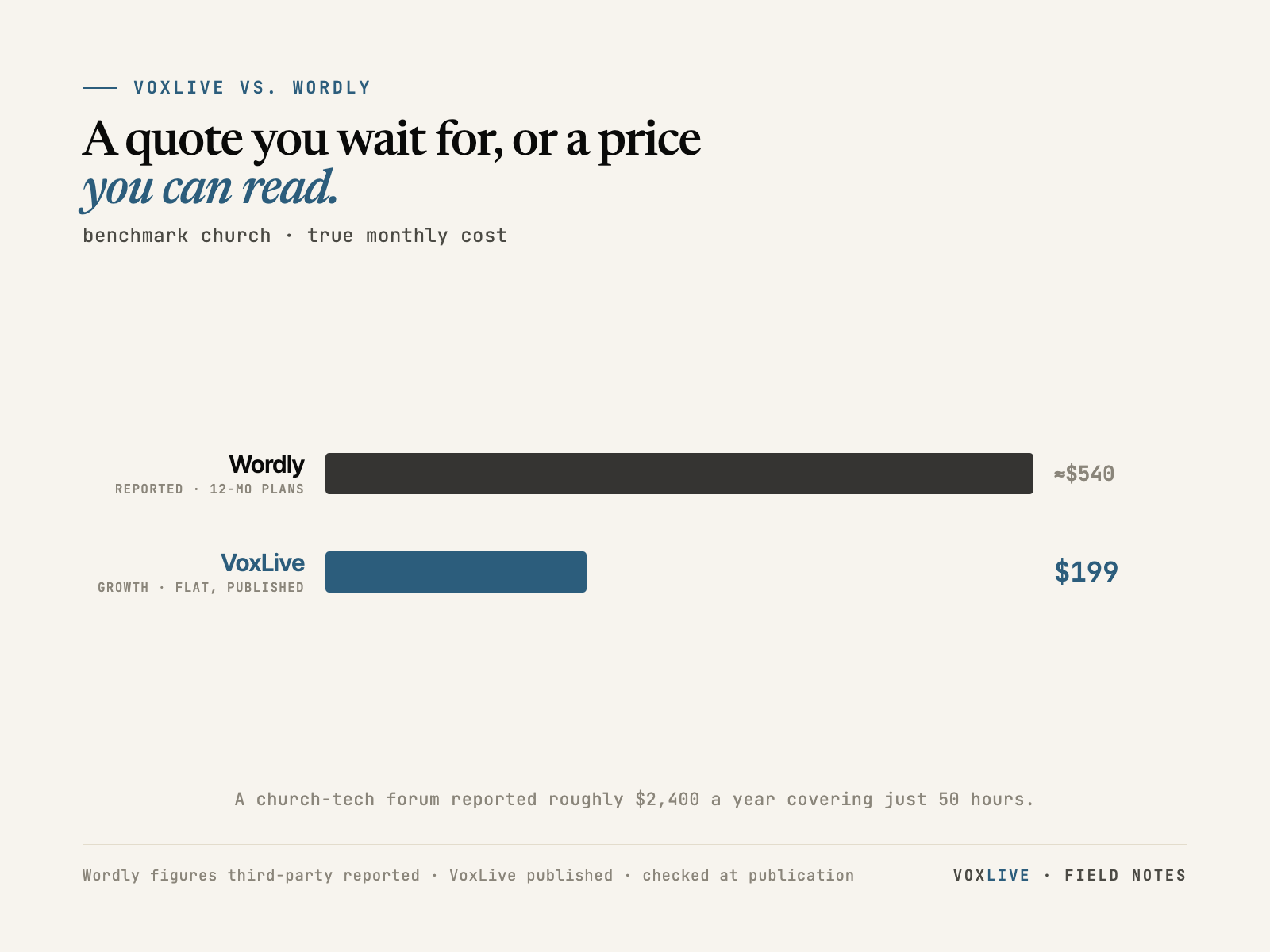
The reported price points are conference-sized. A third-party comparison (updated March 4, 2026; re-checked August 10) lists Wordly at about €500 a month (~$540) on a 12-month plan, and a per-hour figure of €50 that the comparison itself labels "pricing found on Reddit, unverified." Both are single data points — verify against your own quote.
It is a meetings engine that now courts churches. Wordly markets a church vertical today — a "Church Translation & Caption Services" page, a house-of-worship resource hub, a church case study (checked August 10, 2026). The product underneath is the same general-purpose meetings engine: no concept of Bible verses, no worship-service workflow. And it is replace-only: there is no mode that carries your existing human interpreter's voice and lets AI fill only the missing languages.
03 — The mathThe same church, priced through both.
Benchmark church: two services a week (about 9 a month, ~90 minutes each), 2 translated languages, about 100 people following along. Full methodology in the seven-service comparison.
- Wordly at the benchmark: ~13.5 session-hours a month is ~160 hours a year — past its Expand church package (120 hours a year), into Wide Adoption (300). Published price for any package: none. Third-party reference: ≈$540/mo on 12-month plans. True monthly cost: quote required. To Wordly's credit, whatever the quote is, it covers all languages at once — ask for the all-in annual figure at your real hour count, in writing.
- VoxLive at the benchmark: Growth at $199/mo ($1,990/yr) — 2 spoken + 8 caption languages, 22 broadcast hours against the benchmark's ~13.5, up to 250 listeners. Flat and public. Recordings, transcripts, and per-language Bible verse cards included.
04 — The differenceBuilt for the sanctuary, not the summit.
- Published, flat pricing. Every VoxLive price is on the pricing page. The month with five weeks of services costs the same as the month with four.
- Keep your interpreters. If your church already has a volunteer or missionary interpreter, VoxLive carries their live voice to every phone and lets AI cover only the languages they can't. Wordly — like most of the market — replaces the interpreter entirely.
- Scripture, rendered — not just translated. When the preacher references John 3:16, each listener sees the verse from a verified Bible translation in their own language. A meetings engine has no reason to build that; a church tool has every reason.
- A $5 evaluation, not a sales cycle. Wordly's path starts with a quote, or an account-gated online checkout for its smallest packages. Ours starts with a free tier and a $5 First Sunday Pass.
05 — The honest recommendationWho should pick which.
If you are a denomination or network running large annual events — conventions, assemblies, synods — Wordly's maturity and per-event model are a genuine fit, and the nonprofit discount is worth asking about. If you are a congregation that meets every week and needs the same two or three languages every time, the math favors a flat, published price built around that rhythm.
The cheapest way to know is not another comparison page — ours included. Run one real service for $5: the First Sunday Pass unlocks the whole product for one full service, and you decide from your own congregation's experience. If it doesn't work in your sanctuary, the $5 comes back.
SourcesEvery number, dated.
- Wordly pricing page — wordly.ai/pricing, checked at publication and re-verified August 10, 2026: annual hour packages (Starter 10 hrs → Enterprise 500+ hrs), all languages included, "Contact Sales for a Quote," "Get 4 products for one low price," volume/nonprofit discounts advertised. As of August 10, 2026 the two smallest packages can alternatively be bought online (wordly.ai/buy-it-now) after creating an account, with prices shown only inside the logged-in portal.
- Wordly's church vertical — wordly.ai/church-translation, checked August 10, 2026: "For Houses of Worship," church packages Start (5 hrs/month · 60 hrs/year), Expand (10 · 120), Wide Adoption (25 · 300), plus a house-of-worship resource hub and a church case study.
- Hope Translator's pricing comparison (updated March 4, 2026; re-checked August 10, 2026) — hopetranslator.com — lists Wordly at €500/month (~$540) on a 12-month plan, and a per-hour figure of €50 which that page itself labels "pricing found on Reddit, unverified."
- VoxLive pricing — voxlive.app/pricing.
Wordly is a trademark of its respective owner. VoxLive is not affiliated with, endorsed by, or sponsored by Wordly. Prices and features change — always confirm on the vendor's own site before deciding. Corrections welcome: hello@voxlive.app.
Built for the booth, priced for a church.
The AV-team test is one real service, not a demo call. Five dollars, whole product, refunded if your room disagrees.