

If your church already runs a wireless interpretation system — a Williams Sound Digi-Wave, a Listen Technologies ListenTALK, a rack of Retekess receivers — you bought good gear for a real reason, and it works. This page isn't here to tell you it was a mistake. Hardware has genuine advantages a phone-based tool can't match, and we'll name them first. Then we'll make the honest case for the churches that are tired of the receiver bin. We make VoxLive, so weigh what follows accordingly — every price cites the vendor's own listing, with the date we checked it.
01 — Credit firstWhat the hardware still does better.
- No phones required. A receiver is handed to anyone, no smartphone, no account, no data plan. For a congregation where many members don't carry a phone — or won't take one out during worship — that's a real advantage, and it's the honest reason hardware persists.
- No Wi-Fi, no cell signal. Digi-Wave and ListenTALK run on their own radio. A stone-walled basement fellowship hall with no bars and a saturated guest network is exactly where a receiver keeps working and a phone struggles. If your building fights Wi-Fi, respect that.
- One-time capital cost. You buy it once. For a church that runs the same one or two languages for years and hates recurring bills, a paid-off receiver bin has a certain peace to it.
- Rugged and simple. A dedicated receiver does one thing. No notifications, no low-storage warning, no app update mid-sermon.
02 — The real costWhat the receiver bin actually costs to run.
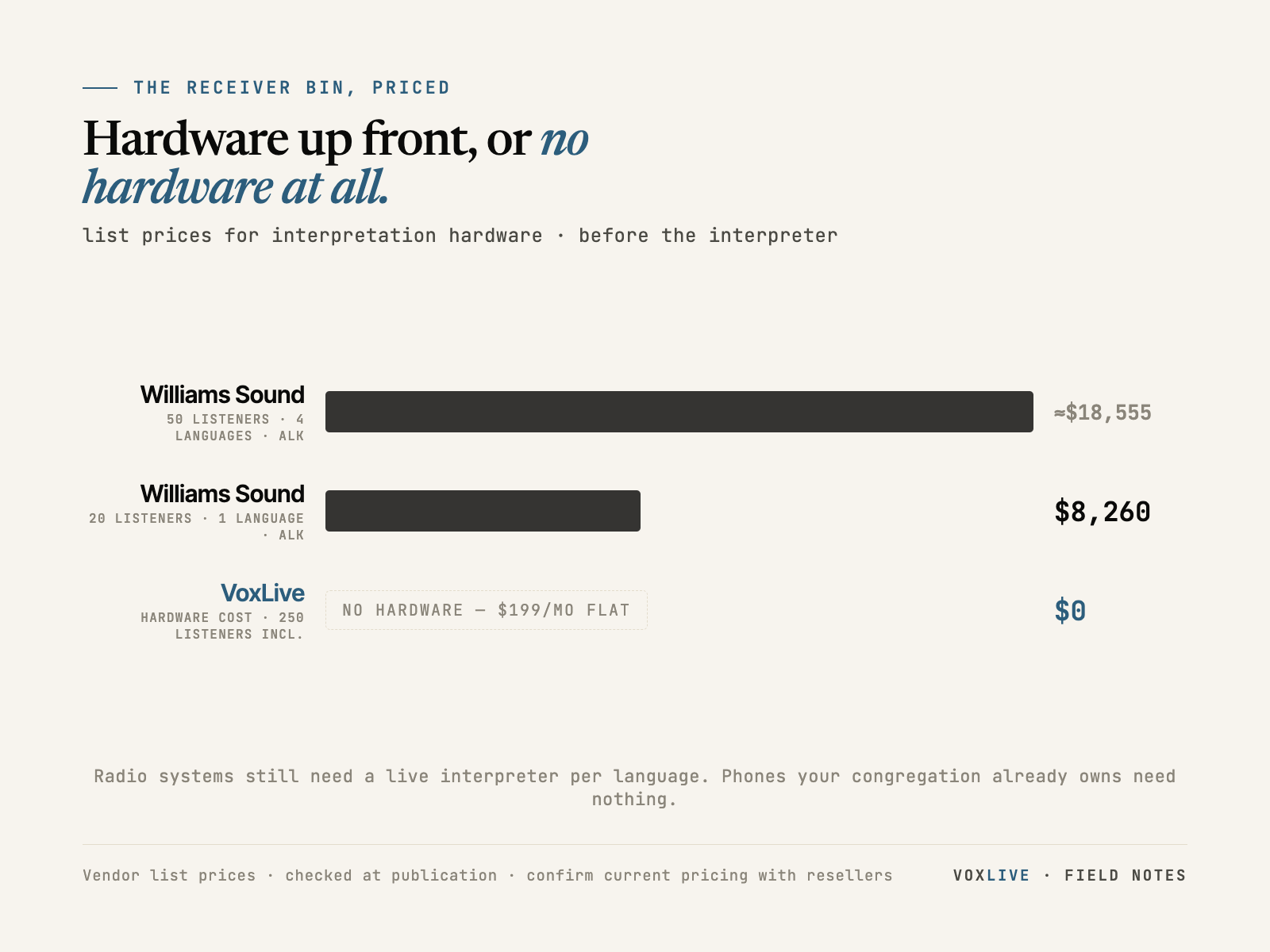
The upfront number is large. As of August 10, 2026, a Williams Sound Digi-Wave system for one language plus floor and 20 listeners lists at $7,094 (street around $6,385) — and it ships with a bag of AAA alkaline batteries. Scale it to 50 listeners and four languages and the alkaline configuration lists around $17,865 (the rechargeable version lists at $21,995 on williamsav.com, August 2026). A single Listen Technologies ListenTALK transceiver lists around $498; a bin of them adds up fast. Budget Retekess T130 kits are far cheaper — a few hundred dollars depending on receiver count — but they don't translate at all: they carry the audio of a live human interpreter you still have to staff for every language.
The recurring cost is people and maintenance. Someone charges the units or swaps batteries. Someone hands them out and runs the sign-out sheet. Someone chases down the three that walked out the door. Someone re-orders the earpieces that break and the units that get lost. None of that shows up on the invoice, but your volunteers pay it every week.
The invoice is the transmitter. The real cost is the volunteer who charges forty receivers the night before and chases down the missing three after the service.
And the receiver only carries a human. Every system on this page moves audio — it doesn't produce translation. Someone has to interpret live, per language, every service. If you don't have a Ukrainian interpreter this week, the Ukrainian channel is silent. Hardware can't cover the language you have no human for. (For how the recurring software options compare on price, see the seven-service cost comparison.)
03 — The alternativeThe translation lives on phones people already carry.
The phone-based approach flips the model: no transmitter to buy, no receivers to charge, no batteries, no sign-out sheet. Listeners scan one QR code — on the screen, in the bulletin, at the door — and follow the service in their language, reading live captions, hearing spoken translation, or both. It runs from a laptop or iPad connected to your sound board.
- Nothing to hand out or collect. The device is the phone in their pocket. No inventory, no charging station, no lost units.
- Add a language without buying anything. A visitor speaks a language you've never served? Turn it on for the service — no new hardware, no interpreter required for the AI-covered languages.
- Captions and audio at once. A receiver gives you one audio channel. A phone gives each listener the choice: read it, hear it, or both — which also serves deaf and hard-of-hearing members that a receiver never did. And it does something a receiver structurally can't: a listener who partly understands the preaching can hear one language, read the other, and put the words together — learning the language while the service runs.
- Flat, published, all-inclusive pricing. No per-unit capital outlay — plans start free, and scale by a flat monthly price with no per-language or per-hour add-on.
04 — The honest objectionWhat about members without a phone?
This is the fair pushback, and it's the one real thing hardware still answers that a phone-based tool has to work to match. So here's the honest answer, not a dodge: put the captions on the projector or a screen at the front. The whole room reads together in the primary language and any others you choose — which also serves your deaf and hard-of-hearing members, and anyone straining to hear from the back row. Members who do carry a phone get their own language privately; members who don't follow the shared screen. Between the two, the no-phone gap closes for most congregations.
Where it genuinely doesn't close — a building with no usable network, or a congregation that needs private, individual audio in many languages with no screen to share — that's exactly where keeping the hardware, or running it alongside phones, is the right call. We'd rather tell you that than pretend the trade doesn't exist. For a look at how a real bilingual church runs the phone-based model in practice, read the case study.
05 — The recommendationWho should switch, and who shouldn't.
If your building fights Wi-Fi, your congregation largely doesn't carry phones, and you run the same one or two languages every year on gear you've already paid off — keep the receivers. They earn their keep. If you're re-ordering earpieces, charging a bin every Saturday, staffing an interpreter per language, and turning visitors away because you don't have their channel, the phone-based model removes all of that and adds languages you could never staff.
You don't have to decide from a spec sheet. Run one real Sunday for $5: the First Sunday Pass unlocks the whole product for one full service — put the captions on the projector, hand your phone-carrying members the QR code, and see how the room follows. If it doesn't work in your sanctuary, the $5 comes back, and your receivers are still in the bin.
SourcesEvery number, dated.
- Williams Sound / Williams AV Digi-Wave interpretation systems — williamsav.com and reseller listing (conferenceroomav.com), checked August 10, 2026: DWS INT 3 400 ALK for 2 presenters (one language plus floor) and 20 listeners lists at MSRP $7,094 (reseller price $6,385), includes DLT 400 transceivers, DLR 400 ALK receivers, earphones, headset mics, charger, and 20 AAA alkaline batteries; a 50-listener, four-language-plus-floor alkaline configuration (DWS INT 5 400 ALK) lists at $17,865 MSRP (reseller price $16,078); the rechargeable variant (DWS INT 5 400 RCH) lists at $21,995 on williamsav.com, checked August 10, 2026.
- Listen Technologies ListenTALK — LK-1 transceiver listed around $498 each (reseller listings, checked July 2026). Confirm current system pricing with an authorized dealer.
- Retekess T130 — retekess.com, checked July 2026: cost-effective tour-guide/interpretation kits typically a few hundred dollars depending on receiver count (exact prices vary by kit and seller); the system carries audio and does not translate — a live human interpreter is required per language.
- VoxLive pricing — voxlive.app/pricing.
Williams Sound, Williams AV, Digi-Wave, Listen Technologies, ListenTALK, and Retekess are trademarks of their respective owners. VoxLive is not affiliated with, endorsed by, or sponsored by any of them. Prices and features change — always confirm on the vendor's own site or with an authorized dealer before deciding. Corrections welcome: hello@voxlive.app.
Retire the receiver basket.
The phones are already in the pews. One QR code replaces the hardware, the batteries, and the person handing them out.