
Palabra is the best-funded competitor we have written about, and we will say so plainly. An $8.4M pre-seed led by Seven Seven Six in 2025, the acquisition of Talo the same year, sub-second latency claims, and a listener flow — scan a QR code, open the browser, pick your language — that mirrors ours almost exactly. The engineering is not the question. The question is what a church pays for a normal month, and which of their several products a church is actually buying. Their own church setup guide answers the second question, and their published prices answer the first. This page walks through both, every claim dated where it appears.
01 — Credit firstWhat Palabra is genuinely good at.
- Funding and pedigree. An $8.4M pre-seed in 2025 led by Seven Seven Six, plus the acquisition of Talo the same year. This is a serious, well-resourced engineering company, and nothing below argues otherwise.
- Latency claims that lead the market. Their homepage claims sub-second latency, and the company told TechCrunch 800 milliseconds. We have not measured it independently; the claims are theirs, and they are aggressive in a good way.
- A listener flow that matches ours. QR code or link, browser, pick a language, hear audio or read captions, nothing to install — with unlimited listeners on the Events and Streams tiers. That is the right design, and they got it right too.
- Published, self-serve prices. All three of their product tabs publish prices with free-trial buttons; only the Business tiers and volume packages are talk-to-sales. That is more transparency than much of this market manages, and it is what makes this page possible.
- Voice cloning, out of the box. Their copy offers auto voice cloning — "clone your pastor's tone" — metered by tier: 2 cloned voices on Starter, 10 on Pro, unlimited on Team. VoxLive includes voice cloning from Growth up, but it is newer and in limited rollout; our first answer to the own-voice question is different, and it comes up below.
- Real event plumbing. 60+ languages, custom glossaries, noise suppression, and professional broadcast outputs across the Events and Streams tiers.
02 — The arithmeticA real month at their published rates.
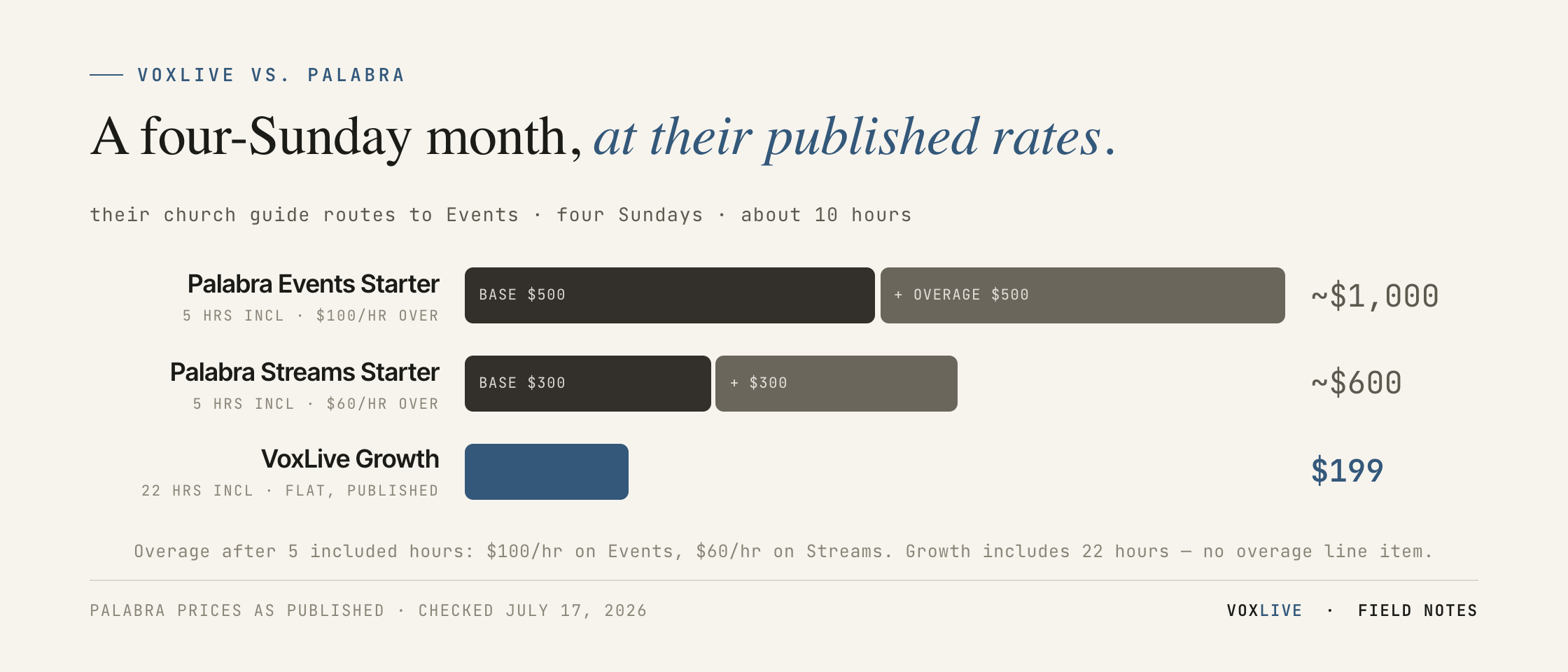
Palabra's church page tells you which product a church should use. Its own how-it-works instructions say to "open Palabra Events in your dashboard." So price the Events tab. As of July 17, 2026, Events Starter is $500 a month for 5 included hours, then $100 per extra hour. The parallel Streams & broadcasting tab starts at $300 a month for 5 hours, then $60 per extra hour.
Now run a normal church month through it. Four services, about 2.5 hours each — the pre-service line check, the service, the long goodbye — is roughly 10 hours a month. Step by step, on their published rates:
- Events Starter: 10 hours minus 5 included leaves 5 hours over. 5 × $100 = $500 in overage. $500 base + $500 overage = about $1,000 for the month.
- Streams Starter: same 5 hours over at $60 each = $300. $300 base + $300 overage = about $600 for the month.
- Stepping up a tier does not rescue it: Events Pro is $1,600 a month for 20 hours; Streams Pro is $800 for 20 hours. At this volume, both cost more than Starter plus its overage.
- Billed yearly their per-month prices drop to 0.75× (and the overage rates drop with them), so the same month runs about $750 on Events Starter and about $450 on Streams Starter. Lower, and still not close.
- VoxLive at the same month: Growth at $199 flat — 22 included hours against the month's ~10, spoken translation in 2 languages plus live captions in 8 running simultaneously, up to 250 listeners, recordings and transcripts included. The month with a fifth service costs the same. And when a church does run past its hours, a broadcast in progress always finishes — there is no overage line item.
Check the arithmetic yourself; it is four lines. The point is not that Palabra hid anything — the rates are published, which we credit. The point is that per-hour overage on a 5-hour meter is event math, and a church is not an event. A church is the same 10 hours, every month, forever.
Their own setup guide says open Palabra Events. Priced there, a four-service month is about $1,000. Our answer to the same month is $199, flat.
03 — The default tabRead carefully which product you are pricing.
There is a wrinkle worth knowing before you compare quotes in a budget meeting. Palabra's church landing page embeds their full pricing widget, and as of July 17, 2026 that widget defaults to the "Meetings & presentations" tab — where Starter is $60 a month. That $60 belongs to a different product built for video calls and presentations (Zoom, Meet, Teams). It is not the product their own setup guide tells churches to open, which is Events, at $500.
None of this is hidden — it is one tab click away, and we read it as a default, not a tactic. But a treasurer skimming the page will anchor on $60, and the number that matches the setup instructions is $500. Even taken at face value, the Meetings meter is 3 hours with $20-an-hour overage — the same ~10-hour month would run $60 + 7 × $20 = $200, on a product shaped like a video call. Whatever you conclude, price the tab their instructions point to.
04 — InterpretersReplaces them, or keeps them.
Palabra's homepage used to say it in the headline — last July it read, verbatim, "Live Voice AI Translator That Replaces Interpreters." The redesign has since retired that line; as of August 10, 2026 the H1 is "The world's fastest real-time speech AI." The stance survives in softer copy: the homepage pitches in-person events with "no interpreter required," and the church page still runs a comparison table — "Palabra AI vs. human interpretation for multilingual worship" — whose case is that "Each additional language requires hiring more interpreters." And there is still no mode anywhere in their marketing, pricing, or docs that carries a live human interpreter's voice to listeners. For a church with no interpreters, that is no loss; AI is the only option either way, and theirs is a capable one.
But many multilingual churches already have a translation ministry — a volunteer who has interpreted the sermon into Spanish for years, a missionary couple covering Mandarin. VoxLive is built to keep them: your interpreter speaks, their live voice reaches every listener's phone through the same system, and AI covers only the languages no human on your team speaks. That is how a real bilingual church runs it in our case study. Palabra leads with cloning the pastor's tone; we lead with carrying the actual human when you have one.
A footnote on the replacement pitch: their church page's comparison table puts the cost case at "About 4× more affordable than interpreters" — their number, live as of August 10, 2026.
05 — Church-as-a-tabWhat the church page does and does not contain.
Church is one industry tab among several on Palabra's site, and the depth matches. Their customer-stories page lists five stories as of July 17, 2026 — none from a church or religious organization. The church page itself carries two testimonials, both anonymous and identified by role only. That is not a criticism of the product; it is a fact about who it has been built around so far.
The feature list says the same thing. There are no Bible features — custom glossaries for sacred terms is the extent of it. No verse detection, no Scripture rendering. When a VoxLive listener hears the preacher reference John 3:16, they see the verse from a published Bible translation in their own language, automatically, on every plan (on free, during its AI trial). A church tool has every reason to build that; a five-industry tool has not yet had one.
And there is the equipment contradiction, which now lives entirely on their church page. As of August 10, 2026, its comparison table says "Works out of the box. No special equipment, booths or receivers required. Runs on your existing devices and setup," while the same page's FAQ answer opens "No special equipment is required. You only need a laptop or tablet connected to your church's audio system and a streaming studio such as OBS or vMix to send the sound to Palabra" — no special equipment, and then a streaming studio, in consecutive sentences. If your booth already runs OBS every service, that requirement costs you nothing — and some booths genuinely do. If it does not, a streaming studio is exactly the volunteer-AV friction a church tool should remove. VoxLive's operator side runs entirely in the browser: a phone or laptop and a QR code cover a service, no streaming studio anywhere in the flow.
06 — Ours to concedeWhere Palabra fits, and who should pick which.
The concessions run both ways. Palabra's Events and Streams tiers carry unlimited listeners; VoxLive's plans have caps (75 on Starter, 250 on Growth, 350 on Pro, 450 on Scale). Palabra's voice cloning is more mature — shipping across its tiers today, metered; ours is included from Growth up but newer and in limited rollout. Our free tier is a one-time trial on a real service: two hours of live translation and one hour of spoken translation in one language, with no card and no deadline. It gives the product one honest audition; it is not free translation indefinitely. And Palabra iterates fast; if they publish a church-shaped price tomorrow, we will update this page. Today, we priced the month the way their site prices it.
So: if you are a conference, a multi-industry events organization, a broadcaster already running OBS or vMix, or you need cloned voices across an event program at scale — Palabra is a credible, well-funded choice, and their published prices may pencil out at your shape. If you are a congregation that meets every week, wants its interpreters carried rather than replaced, wants Scripture rendered rather than machine-translated, and wants the month with five services to cost the same as the month with four — that is the shape VoxLive is built around, at flat published prices from $59 to $789 a month.
The cheapest way to know is not this page — it is one real service. The $5 First Sunday Pass unlocks everything in the Pro plan for one full service, and you decide from your own congregation's experience. If it doesn't work in your sanctuary, the $5 comes back.
07 — FAQHonest questions, honest answers.
How much does Palabra cost for a church?
As of July 17, 2026, Palabra publishes self-serve prices across three product tabs. Its own church setup guide points churches to Palabra Events, where Starter is $500 a month for 5 included hours plus $100 per extra hour. Streams Starter is $300 a month for 5 hours plus $60 per extra hour, and the Meetings tab starts at $60 but prices a different product built for video calls. A church broadcasting about 10 hours a month lands around $1,000 on Events Starter or about $600 on Streams Starter. VoxLive publishes a flat ladder: Free, Starter $59, Growth $199, Pro $449, and Scale $789 a month, with no overage line item on any plan.
How does Palabra pricing work out for a weekly church?
Run the month at Palabra's published rates as of July 17, 2026. Four services at about 2.5 hours each is roughly 10 hours. Events Starter includes 5 hours for $500, and the remaining 5 hours bill at $100 each — about $500 more, so about $1,000 for the month. Streams Starter includes 5 hours for $300, and the remaining 5 bill at $60 each — about $600 total. VoxLive Growth is $199 flat with 22 included hours, a broadcast in progress always finishes, and there is no overage line item.
Does Palabra work with human interpreters?
No mode for that appears anywhere on its site as of August 10, 2026 — the homepage pitches in-person events with no interpreter required, and the church page runs a comparison table against human interpretation for multilingual worship. VoxLive is built the other way: your interpreter speaks, their live voice reaches every listener's phone, and AI covers only the languages no human on your team speaks.
What is the difference between VoxLive and Palabra?
Both send live translated audio and captions to listeners' phones through a QR code with no app to install. The differences as of July 17, 2026: Palabra prices churches through its Events and Streams products with metered hours and per-hour overage, positions itself as replacing interpreters, lists no named church customers and no Bible features, and its church FAQ calls for a streaming studio such as OBS or vMix. VoxLive prices flat with no overage line item, carries a live human interpreter's voice alongside AI languages, shows detected Bible verses in each listener's language, and runs the operator side entirely in the browser.
Does a church need OBS or vMix to use Palabra?
According to Palabra's own church-page FAQ as of August 10, 2026, setup needs a laptop or tablet connected to the church's audio system and a streaming studio such as OBS or vMix — while the comparison table on the same page says it works out of the box with no special equipment, booths or receivers required. Both statements are theirs, on the same page; the FAQ is the one with the setup steps, so plan around it. VoxLive requires no streaming studio: the operator side runs entirely in the browser, and a phone or laptop plus a QR code covers a service.
SourcesEvery number, dated.
- Palabra pricing widget — palabra.ai/pricing and palabra.ai/industries/church (the same widget on both pages), checked July 17, 2026. Meetings & presentations (default tab): Starter $60/month ($45 billed yearly) · 3 hours · $20/hour overage ($15 yearly); Pro $150/$113 · 10 hours · $15/$11.50; Team $500/$375 · 50 hours · $10/$7.50. In-person events: Starter $500/$375 · 5 hours · $100/$75; Pro $1,600/$1,200 · 20 hours · $80/$60; Team $3,000/$2,250 · 50 hours · $60/$45. Streams & broadcasting: Starter $300/$225 · 5 hours · $60/$45; Pro $800/$600 · 20 hours · $40/$30; Team $1,500/$1,125 · 50 hours · $30/$22.50. Business tiers custom-priced. Cloned-voice counts are tier-metered in the widget's feature lists: 2 on Starter, 10 on Pro, unlimited on Team. Yearly prices are 0.75× the active monthly price on every card; several cards display higher struck-through anchor prices; the "save up to 62%" toggle claim only reaches 62% against those anchors. Widget footer: "All plans include sub-second latency, 60+ languages, and zero data retention."
- Church setup route — palabra.ai/industries/church, checked July 17, 2026: the how-it-works instructions say "open Palabra Events in your dashboard"; the embedded pricing widget defaults to the "Meetings & presentations" tab; two anonymous role-only testimonials. Re-checked August 10, 2026: the "Palabra AI vs. human interpretation for multilingual worship" comparison table's equipment row says "Works out of the box. No special equipment, booths or receivers required. Runs on your existing devices and setup," while the same page's FAQ answer opens "No special equipment is required. You only need a laptop or tablet connected to your church's audio system and a streaming studio such as OBS or vMix to send the sound to Palabra"; the same table's cost line reads "About 4× more affordable than interpreters."
- Homepage claims — palabra.ai, checked July 17, 2026: H1 "Live Voice AI Translator That Replaces Interpreters"; sub-second ("<1sec") latency; "9.3× cheaper than a human interpreter"; "No special equipment, booths or receivers required"; "Auto voice cloning out of the box." Re-checked August 10, 2026: the homepage has been redesigned — the H1 is now "The world's fastest real-time speech AI," the 9.3× and equipment lines no longer appear on it, and the in-person events pitch reads "no interpreter required." The equipment wording now lives on the church page's comparison table; the only cost multiplier still published is the church page's "About 4× more affordable than interpreters."
- Customer stories — palabra.ai/customer-stories, checked July 17, 2026: five stories, none from a church or religious organization.
- Funding — TechCrunch, August 14, 2025: $8.4M pre-seed led by Seven Seven Six. The 800-millisecond latency figure is the company's own claim relayed in that coverage, not an independent measurement.
- Talo acquisition — Businesswire, November 10, 2025.
- The named-church case study referenced above — Solid Foundation Texas, weekly real services.
- VoxLive pricing — voxlive.app/pricing.
Palabra is a trademark of its respective owner. VoxLive is not affiliated with, endorsed by, or sponsored by Palabra. Prices and features change — always confirm on the vendor's own site before deciding. Corrections welcome: hello@voxlive.app.
Church-first, not church-as-a-tab.
Flat published plans, no per-hour overage, built and run in a real sanctuary every week. Decide from your own pew.