

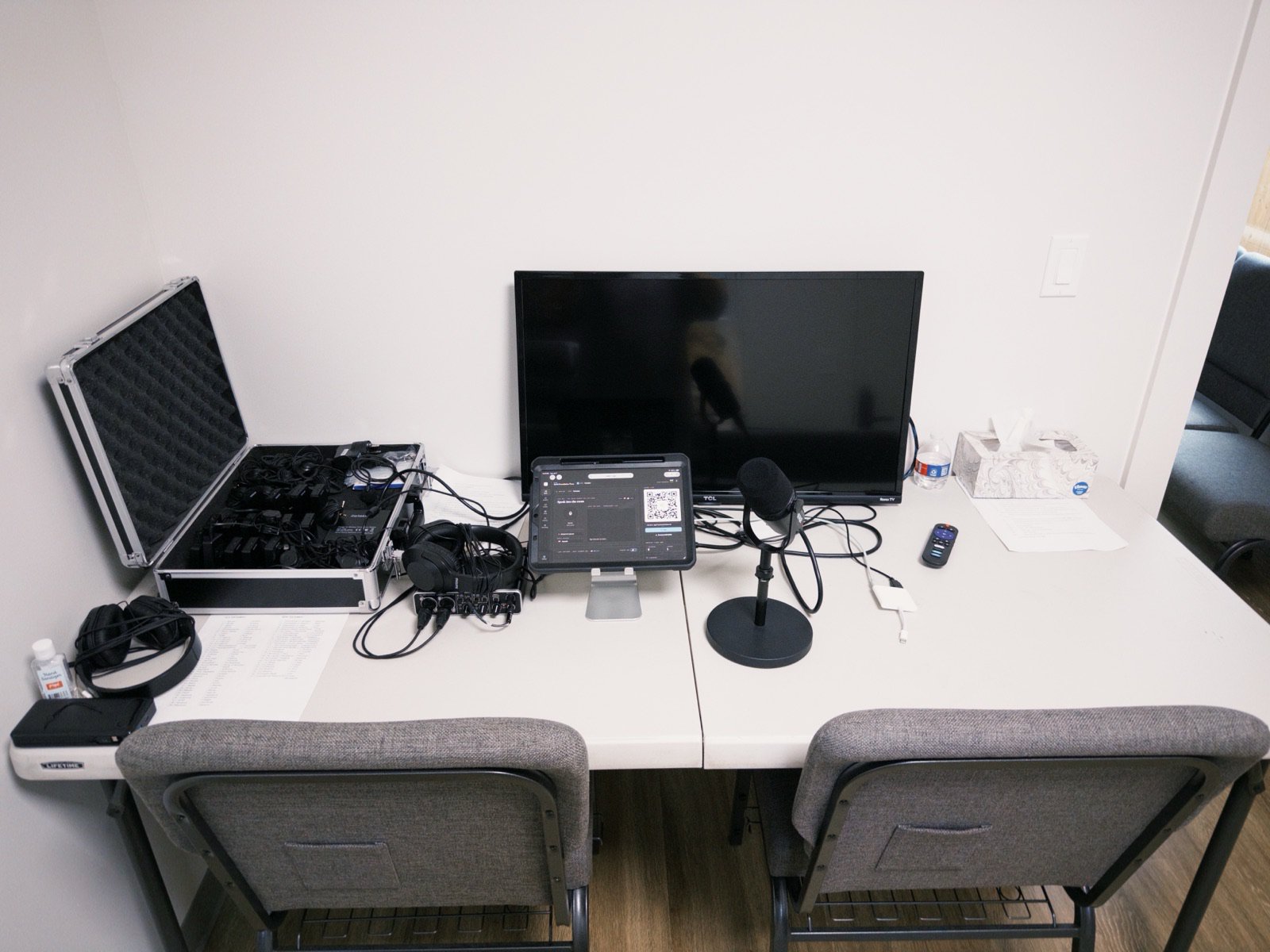
Full disclosure, before anything else: we build VoxLive, and Solid Foundation Texas is my home church. I run its AV team. Every feature VoxLive ships gets tested here first, on live services, before any other church sees it. That means two things for how you should read this case study: I am the least neutral narrator possible, and this is also the one church whose numbers I can show you straight out of our own database, with nothing polished for marketing.
01 — The churchA bilingual church, by the numbers.
Solid Foundation Texas is a bilingual church — Russian and English both live in the room, and services move between the two, often inside the same service.
The language mix is the entire reason a translation product matters in this room. Roughly four in ten speak Russian as their primary language, and about nine in ten understand both Russian and English well enough to follow a service in either. The people left out are the margin, not the middle: on any given week it's a handful — eight or ten in a room of two hundred — American members whose primary language is English, a percent or two who understand Romanian and English but not Russian, a few German-primary members. VoxLive's job is to carry the service into each of those native languages — and to every future visitor who walks in speaking something else, because a church can't grow past the languages it preaches in.
02 — The servicesTwo a week, and a translation team that stayed.
The church holds two services a week — normally a Friday service and a Sunday service, one each day. A service here usually carries more than one sermon, which is normal for Slavic churches and matters for how translation actually works.
The church has its own translation team, translating for the congregation in the room. The first sermon of a service normally has a translator on stage at the pulpit, alongside the preacher. The second and third sermons are normally the preacher alone — and for those, the translation team works from the translation booth, with VoxLive carrying the translation to every phone in the room.
That division of labor is the point. VoxLive did not replace the team; it sits alongside them — carrying their work beyond the room's speakers, covering the sermons where no one is on stage with the preacher, and translating into the languages nobody on the team speaks.
03 — The feedLivestream mode, the simplest possible setup.
Most tools in this category get run from a phone or a laptop microphone somewhere in the room. Here, the broadcast primarily runs in livestream mode: VoxLive pulls its audio from the church's existing livestream. It is the simplest way to run the product — no computer or laptop at the soundboard, and nobody has to set anything up in the booth before a service.
We also tested the direct soundboard feed rigorously, and it works — that path is proven and available. Livestream mode is what actually runs today, because that is what being the test-ground church means: the newest path runs here first, on real services, before any other church is asked to trust it.
04 — Two momentsWhat the beta group found on their own.
Two moments from the first months stand out, both from the same group of people.
The first beta test. I gave the listen link to members of our congregation who are American — they understand maybe ten percent of the Russian. They told me they could now follow what was being said in real time, and watch the Bible verses appear on their screens as they were referenced — hearing and reading the translation live. There is a quieter effect underneath that: hearing the Russian while reading the English, they start matching words to words — the captions double as a language bridge, and a partial understander picks up more of the other language mid-service.
The two-translations moment. During a first sermon — the one with the human translator on stage — those same members kept VoxLive open. They could hear our translator rendering the Russian preacher into English, and at the same time read how VoxLive translated the same words into captions. Two independent translations of the same sentence. No translator is perfect, human or machine — and having both gave them an enormous amount of context.
Two independent translations of the same sentence — and no translator is perfect, human or machine.
Nobody designed that behavior, and nobody asked them to do it. It is the argument for augmenting a translation team instead of replacing it, made unprompted, from a pew.
05 — The numbersStraight from the database.
These figures come from VoxLive's own metering for this church, as of July 6, 2026. First broadcast: April 17, 2026 — a Friday. Since then the meter has recorded about thirty-four hours of live mic time — roughly four hours in the back half of April, eleven in May, ten in June, and nine already in the first week of July — across hundreds of runs: full services, and the constant testing a test-ground church signs up for. The meter is conservative by design: it counts only while audio is actually flowing, so setup time and silence don't pad the number.
A full service typically shows up as 60 to 75 minutes of live audio, and the bigger Sundays run 2 to 2.4 hours across the morning. The listener peak on record is 7 distinct devices in one service, on May 17, with 6 on July 5.
06 — The test groundWhat this proves, and what it doesn't.
The unglamorous part of "every feature ships here first" is that everything that has ever gone wrong with VoxLive has gone wrong here first, in front of people I sit next to. That is the arrangement working as intended: a failure at Solid Foundation is a Sunday-morning apology and a fix; the same failure at a church I have never visited would be a silent churn. Every guard rail now protecting other churches' broadcasts was earned on a live service in this room.
Every fix that now protects another church's service broke here first, on a live one.
This case study doesn't prove VoxLive scales to thousands of listeners — these numbers can't carry that claim, and I won't make it here. What it does show: a real bilingual church with 170 to 200 people attending, two services a week, a translation team that kept its place on the platform, and a translation stack that has to survive its builder's own church watching.
If you want to see how it behaves in your room rather than mine: run one real Sunday for $5. The First Sunday Pass unlocks the whole product for one full service — decide from your own congregation's experience. If it doesn't work in your sanctuary, the $5 comes back.
Run what they run.
Same product, your sanctuary, one real service — five dollars, refunded if it doesn't work in your room.