

01What we noticed.
I run the AV team at my own church - bilingual, Russian and English, two services a week. Most of the room understands both languages fine. We built the captions for the handful who don't: a few members, the occasional visitor, and whoever walks in next.
Then people I didn't expect started using them. Members who catch maybe one word in ten of the Russian preaching told me they could now follow what was being said in real time. Not from the captions alone - from the combination. The preacher in Russian in their ears, the English on their phone, both in the same moment.
02The mechanic.
There is no feature called this. It is just what happens when both channels run at once.
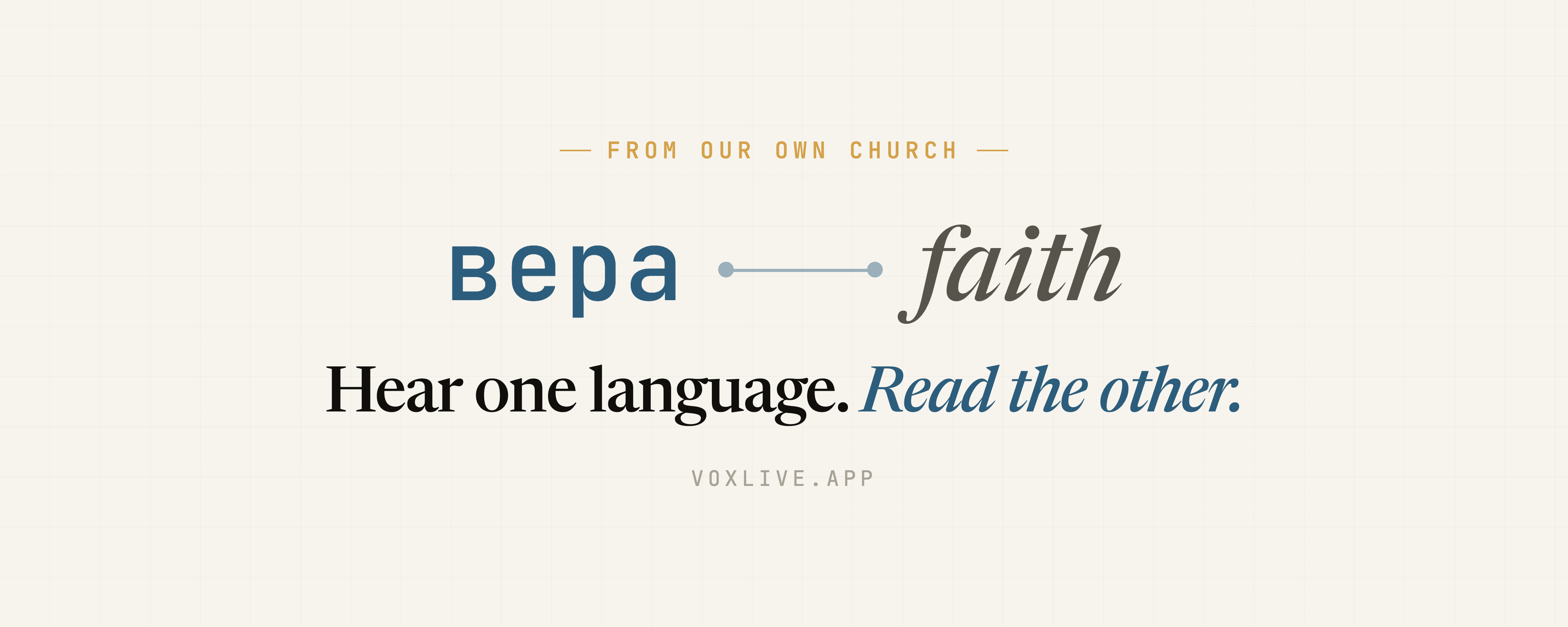
The sermon is preached in Russian. The phone shows live captions in English, a beat behind the voice. The listener hears the sound of one language and reads the meaning in the other, and their brain starts stitching the two together. A word they have heard in church their whole life suddenly has a shape in English. A phrase they only knew in English turns out to have been in the sermon all along.
Some of our people are genuinely learning Russian this way - in the pew, during the service, with no class and no flashcards. We did not design this. We watched it happen, every Friday and every Sunday.
03Why this matters in a bilingual church.
Here is the part that surprised me as the builder. I thought captions were for the margin - the few who cannot follow the preaching language, plus every future visitor, because a church cannot grow past the languages it preaches in. That is still the core job.
But in a bilingual church, the middle uses them too. The second-generation kids who understand the preaching but think in English. The spouse who has attended for years and understands more than they speak. For them the captions are not an accommodation. They are a bridge between the two languages the church already lives in - and that is why a room where ninety percent understand both languages still has phones out during the sermon.
04If your church lives between two languages.
Captions run in 60 languages, and the pair does not matter: Russian preaching with English captions, Spanish preaching with English captions, English preaching with Korean captions for the grandparents. The mechanic is the same - hear one, read the other, put them together.
If someone at your church already translates live, their voice carries to every phone too, free on any plan, and the captions run alongside it. Nothing about this replaces a translation team - the bridge is one more thing the same system does.
05FAQ.
Can a listener hear the original language and read a translation at the same time?
Yes. Audio and captions are independent - each listener picks what they hear and what they read, and can change either mid-service.
Does this replace a human translator?
No. If your church has a translator, their live voice carries to every listener's phone free on any plan. AI covers the languages your team does not, and captions run alongside either.
Which languages can the captions run in?
60 languages, on every plan. The preaching language and the caption language can be any pair.
See the bridge at your own service.
Captions and spoken translation together, for one real service, five dollars - refunded if it doesn't work in your sanctuary.